
Key local data points:
Richmond County, GA recorded 137 storm events between 2015 and 2024, with an estimated $500+ million in total county property damage over that period — almost entirely driven by Hurricane Helene in September 2024 (NOAA Storm Events Database, 2024).
Columbia County, GA recorded 139 storm events over the same 2015–2024 period, with an estimated $225+ million in property damage, again concentrated in the September 2024 Helene event (NOAA Storm Events Database, 2024).
Augusta's city government submitted approximately $87 million in public infrastructure costs to FEMA following Hurricane Helene, with debris removal alone accounting for roughly $67 million of that total (Augusta city officials / FEMA public assistance records, 2024–2025).
Hurricane Helene (September 2024) — The Headline Event
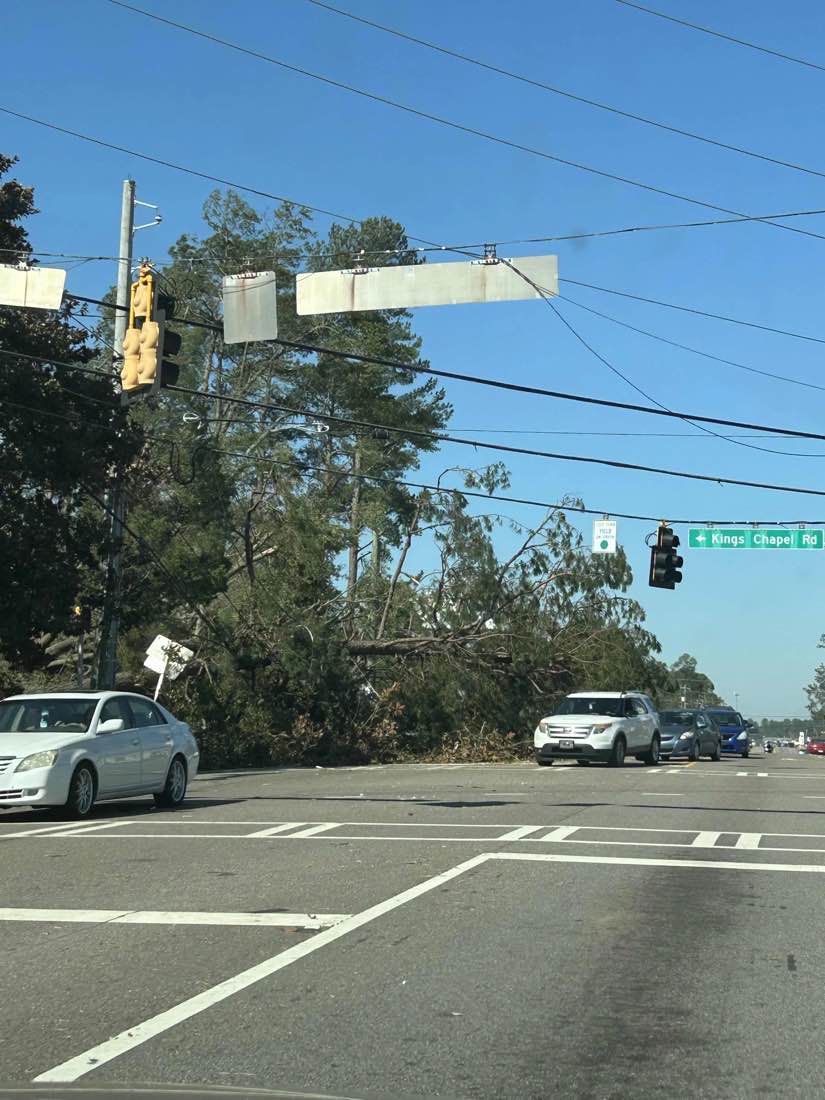
Hurricane Helene made landfall on the Florida Big Bend coast as a Category 4 storm on the evening of September 26, 2024, tracking rapidly northward. By the early morning hours of September 27, the storm arrived over the CSRA — still producing hurricane-force winds — delivering what the National Weather Service Columbia characterized as "unprecedented" damage to the Augusta area.
Several days of heavy rainfall preceding the storm's arrival saturated soils across Richmond and Columbia counties. This pre-saturation was critical: Augusta's dominant tree species — loblolly pine (Pinus taeda) — has shallow root systems that fail en masse in waterlogged sandy loam soils. The combination of fully saturated ground and 80+ mph sustained gusts produced catastrophic tree failure rates across the urban forest.
| Metric | Richmond County, GA | Columbia County, GA | Source |
|---|---|---|---|
| NOAA property damage estimate | $500 million | $225 million | NOAA Storm Events Database |
| NOAA crop damage estimate | $500,000 | $500,000 | NOAA Storm Events Database |
| Direct fatalities (falling trees) | 6 | 1 | NWS Columbia / Wikipedia Effects of Hurricane Helene in Georgia |
| Injuries recorded (NOAA) | 6 | — | NOAA Storm Events Database |
| Homes damaged or destroyed | 9 destroyed / 278 damaged (reported figures) | 248 destroyed / 4,755 damaged | NWS impact narratives |
| Peak wind gust recorded | 82 mph (Augusta Bush Field) | Not separately recorded | NWS Columbia post-storm survey |
| Rainfall total (Evans GA) | 12.37 inches (once-in-500-year event) | NWS Columbia | |
| Trees removed from Augusta rights-of-way | ~17,000 (city officials) | Not separately enumerated | Augusta city officials / WJBF reporting |
| Augusta public infrastructure costs submitted to FEMA | ~$87 million total; ~$67 million debris removal | Augusta city officials / Tetra Tech recovery consultant | |
| Tree canopy loss (NWS characterization) | Exceeded 75% in some neighborhoods; up to 90% in worst-affected areas | NWS Columbia post-storm survey | |
| FEMA disaster declaration | FEMA Disaster #4830 — Georgia; issued October 2024; Richmond and Columbia counties both included | FEMA.gov | |
Note on NOAA damage figures: NOAA's Storm Events Database property damage estimates are compiled by local NWS offices from preliminary assessments. These represent the best available county-level official figures at time of database entry. Actual economic losses may differ from insurance payout totals. The Richmond County $500M figure reflects the NOAA-recorded estimate for the September 27, 2024 tropical storm event.
10-Year Storm Event History — Richmond County & Columbia County (2015–2024)
The Augusta area sits in the primary storm corridor connecting Gulf of Mexico hurricane tracks with the Appalachian foothills — a geography that concentrates tropical remnants, severe convective outbreaks, and heavy rainfall events across the CSRA every year. The following tables are derived directly from the NOAA Storm Events Database.
Richmond County, GA — All Event Types (2015–2024)
| Event Type | Event Count (2015–2024) | Notes |
|---|---|---|
| Thunderstorm Wind | 71 events | Most frequent event type; $123,550 property damage excluding 2024 Helene |
| Hail | 18 events | Includes golf-ball-sized events in summer convective seasons |
| Strong Wind | 8 events | Non-thunderstorm wind events, often late-season frontal passages |
| Flash Flood | 7 events | Savannah River basin flooding; CSRA topography concentrates runoff |
| Heavy Rain | 6 events | Standalone heavy precipitation events |
| High Wind | 4 events | Non-convective high-wind advisories |
| Tropical Storm | 3 events | 2018 (Michael remnants), 2023 (Idalia remnants), 2024 (Helene) |
| Lightning | 2 events | Direct lightning damage events recorded separately |
| Wildfire | 1 event | — |
| Winter Weather | 1 event | Ice/snow events affecting the CSRA are relatively rare |
| TOTAL (all types) | 137 events | Total property damage: $500+ million (NOAA, 2015–2024) |
Columbia County, GA — All Event Types (2015–2024)
| Event Type | Event Count (2015–2024) | Notes |
|---|---|---|
| Thunderstorm Wind | 84 events | Most frequent; $20,560 property damage excluding 2024 Helene |
| Hail | 18 events | Similar frequency to Richmond County |
| Flash Flood | 11 events | Columbia County's lower-lying terrain increases flood frequency |
| Tropical Storm | 2 events | 2018 (Michael remnants) and 2024 (Helene) |
| High Wind | 3 events | — |
| Strong Wind | 2 events | — |
| Heavy Rain | 2 events | — |
| Flood | 1 event | — |
| Tornado | 1 event | Columbia County recorded 1 confirmed tornado in this period |
| Lightning | 2 events | — |
| Winter Weather | 1 event | — |
| TOTAL (all types) | 139 events | Total property damage: $225+ million (NOAA, 2015–2024) |
Storm damage to your trees? Call to connect with a local contractor.
Call (888) 217-7987 — Free EstimateNotable Storm Events — CSRA Tree Damage Context
Beyond Hurricane Helene, the CSRA's tree canopy and private properties have been affected by a recurring pattern of tropical remnants and severe convective storms over the past decade:
| Event | Date | CSRA Impact | NOAA Event Type |
|---|---|---|---|
| Hurricane Helene | September 27, 2024 | 82 mph gust at Augusta Bush Field; 12+ inch rainfall; 17,000+ trees removed from Augusta rights-of-way; $500M Richmond County property damage (NOAA); 7 CSRA fatalities | Tropical Storm (NOAA classification at county level) |
| Tropical Storm Idalia remnants | August 30, 2023 | Trees blown down across Richmond and Columbia counties; limited structural damage | Tropical Storm (Richmond County NOAA record) |
| Hurricane Michael remnants | October 10, 2018 | Tropical storm conditions across CSRA; tree damage in Augusta and Columbia County | Tropical Storm (both counties NOAA records) |
| June–July 2015 severe convective outbreak | June–July 2015 | Multiple thunderstorm wind events; notable damage near Nixon ($48,000 property damage) and National Hills/Augusta ($52,000 combined property damage) in Richmond County | Thunderstorm Wind (NOAA) |
| June 17, 2016 severe thunderstorm | June 17, 2016 | 91-knot estimated gust recorded in Leah (Columbia County); 1 injury | Thunderstorm Wind (NOAA) |
| July 20, 2023 convective outbreak | July 20, 2023 | 11 separate thunderstorm wind events in Columbia County in a single day; wind speeds 60–65 knots across multiple locations | Thunderstorm Wind (NOAA) |
What Storm Frequency Means for Augusta Tree Owners
With 137 recorded storm events in Richmond County and 139 in Columbia County over the 2015–2024 decade — roughly one event per month across both counties — the CSRA is not a low-risk weather environment for tree owners. The practical implications for Augusta homeowners:
- Loblolly pine failure risk is compounding. Each saturation event weakens root anchoring in already-shallow sandy loam. A tree that survived the 2018 Michael remnants and the 2023 Idalia remnants may have root system damage that makes Helene-class winds catastrophic.
- Hanging limbs ("widow makers") are chronic between events. Thunderstorm wind events at 50–70+ knots — documented regularly in both counties — break and lodge limbs without fully toppling trees. A hanging limb from a 2023 convective event can fall on its own schedule with no warning.
- Post-storm demand surges are predictable. The Augusta contractor market enters post-storm triage mode within hours of any named event. Homeowners who waited for Helene-related tree work faced weeks-long backlogs. Proactive removal and hazard assessment before storm season (April–November) consistently produces shorter wait times and lower prices.
- Insurance documentation windows are short. After a major event, adjusters are overwhelmed. Photo documentation of existing tree condition before a storm is valuable evidence if you later need to file a claim for post-storm damage.
Data Source and Methodology Notes
All storm event counts and property damage figures cited on this page are drawn from the NOAA National Centers for Environmental Information (NCEI) Storm Events Database, available at ncei.noaa.gov/stormevents. The database is populated by local National Weather Service offices using storm reports from trained spotters, official weather stations, emergency management records, and media/public reports.
Important limitations: NOAA's property damage estimates are preliminary assessments compiled close to the event date, not final insurance payouts or economic loss surveys. They represent the best available county-level official record, not total insured or economic loss. For Hurricane Helene specifically, the $500M Richmond County figure and $225M Columbia County figure reflect NOAA's official database entries — they should be understood as estimates, not verified insurance totals.
Additional Helene-specific figures (wind gusts, rainfall totals, tree removal counts, city FEMA submissions) are sourced from National Weather Service Columbia (SC) post-storm reports and Augusta city officials' public statements, as reported by WRDW and WJBF Augusta.
For direct data access: the NOAA Storm Events Database can be queried by county, date range, and event type at the URL above. Richmond County, GA FIPS code is 13245; Columbia County, GA FIPS code is 13073.
Common Questions About Augusta Storm Damage
How much damage did Hurricane Helene cause in Augusta GA?
The NOAA Storm Events Database records $500 million in property damage for Richmond County and $225 million for Columbia County from the September 27, 2024 event. Augusta's city government submitted approximately $87 million to FEMA for public infrastructure costs, with debris removal comprising roughly $67 million of that total. These are separate accounting frameworks — NOAA's figure covers all county property damage; Augusta's FEMA submission covers only public-sector infrastructure and debris costs.
How many storm events does Augusta average per year?
Based on the NOAA Storm Events Database for 2015–2024, Richmond County averages approximately 13–14 storm events per year across all types (137 events over 10 years). Columbia County averages approximately 13–14 events per year as well (139 events over the same period). Thunderstorm wind events are by far the most frequent type in both counties.
What wind speeds did Hurricane Helene reach in Augusta?
The National Weather Service recorded an 82 mph wind gust at Augusta Bush Field (Augusta Regional Airport) during Helene on September 27, 2024. The NWS Columbia office characterized the broader CSRA damage pattern as consistent with at least 80 mph gusts across a 60-mile swath. These were not brief gusts — sustained hurricane-force conditions persisted over the area for an extended period.
How much does emergency tree removal cost in Augusta GA?
Emergency tree removal in Augusta typically runs 20–40% above standard pricing. Standard ranges: small trees under 30 ft ($300–$600), medium trees 30–60 ft ($600–$1,400), large trees 60–80 ft ($1,400–$2,500), very large trees 80+ ft ($2,500–$4,500+). Emergency premiums of $300–$600 above these ranges are common after major events. See our full Augusta tree removal cost guide for detail.
Does homeowner's insurance cover storm tree damage in Augusta?
Standard Georgia homeowner policies (HO-3) typically cover tree removal when a tree has fallen on and damaged a covered structure. A tree that fell in the yard without hitting anything is usually not covered. Document damage with photos before any work begins. Contact your insurer to open a claim before the contractor starts work if possible. For Augusta-area emergency response, see our emergency tree removal page.
Storm Damage to Your Trees? Connect with a Local Contractor
If you have storm-damaged trees on your property — hanging limbs, uprooted root balls, cracked leaders from Helene or any prior event — don't wait for the next storm to make the decision for you.
Call (888) 217-7987 — Free EstimateAlso see: Emergency Tree Removal · Tree Removal Cost Guide · Georgia Permit Requirements